Arbequina, Hojiblanca, Farga and Leccino offer different forms and foliage for an ornamental planting. Their appearance is one part of the choice. The light, drainage, space and care a particular tree will receive matter just as much.
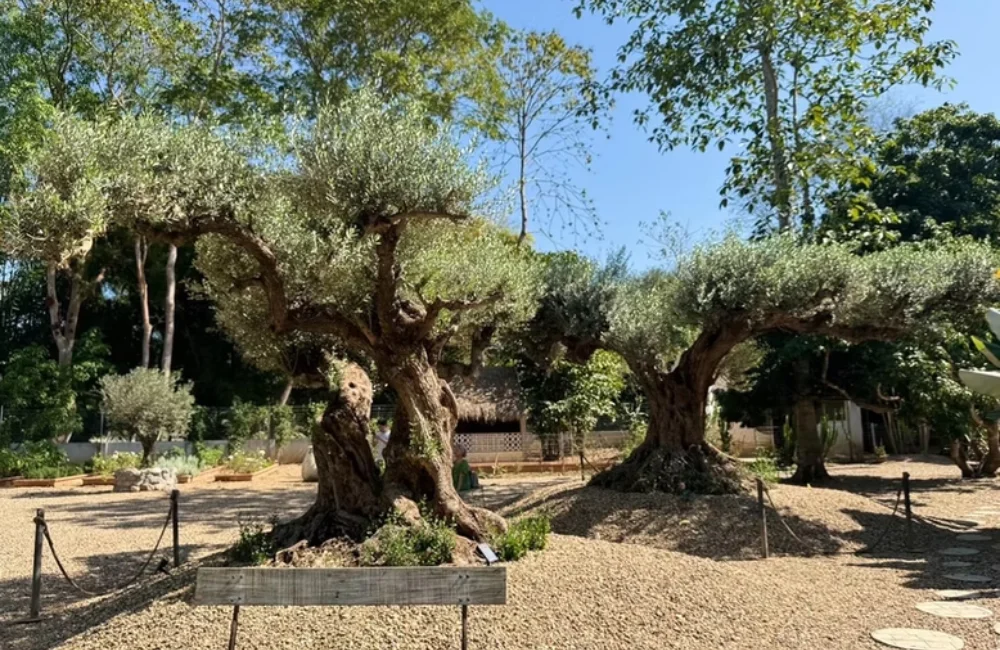
Four varieties to compare
Arbequina
This Spanish cultivar is associated with relatively small foliage and a fine-textured canopy. Its compact appearance can suit a restrained garden composition or a suitably sized container. Growth and performance still depend on the individual tree and its site.
Hojiblanca
The name refers to pale foliage; the leaf undersides can give the canopy a silvery effect in the light. It can be an expressive focal tree. See the Hojiblanca profile for its form and selection considerations.
Farga
Mature Farga specimens may have notably sculptural, twisting trunks. Age and form differ between trees, so inspect the actual specimen rather than assuming every Farga is ancient. A large tree also calls for a plan for access, placement, drainage and after-planting care. See the Farga profile.
Leccino
This Italian cultivar can develop a spreading canopy with darker green foliage. Its disease response and suitability cannot be guaranteed from a cultivar name alone; ask how the actual tree has been prepared and how it will be grown. Leccino and Lechín are different cultivars despite their similar names. See the Lechín profile.
Which variety should you choose?
Arbequina and Leccino are two options to compare. Start with the desired size and visual character, then review sun, root space, drainage, access for delivery and a realistic care plan. The five-step planting article explains the practical preparation.
Choosing with Olive De Casa
Ask to see the individual tree and discuss its form, condition, container or planting position and preparation history. Contact our team to confirm current varieties and service availability.
Frequently asked questions
Can an ornamental olive tree produce fruit?
Fruiting can occur, but it depends on cultivar, maturity, conditions and seasonal cues. An ornamental purchase does not guarantee a crop.
Can an olive tree be kept indoors?
It needs substantial light and suitable drainage. A bright indoor position may work for some movable specimens, but a dim room is not equivalent to outdoor sun. Review the room and the individual tree before choosing a position.
Is the Thai “makok” the same plant as the Mediterranean olive?
No. Similar common names can refer to different botanical plants. Check the scientific name when selecting Olea europaea.