A black, soot-like film on leaves or stems can be alarming. Sooty mold grows on the sticky honeydew left by certain sap-feeding insects. It sits on the plant’s surface rather than invading the leaf tissue. A heavy coating can still shade leaves and reduce photosynthesis, so the useful first step is to find out where the honeydew is coming from.
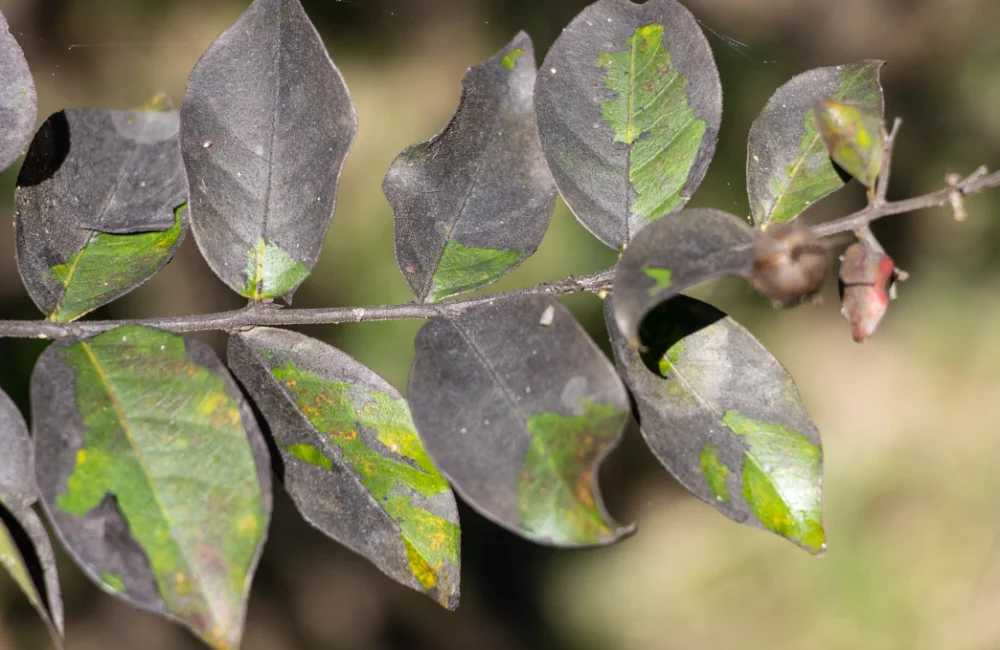
Why the black coating appears
Aphids, mealybugs, whiteflies and some scale insects release honeydew as they feed. Look on the undersides of leaves, new growth and twigs. Sticky patches or ants moving among the insects can help locate an infestation. A nearby overhanging plant may be the source even when the black coating appears on a different tree.
Good drainage matters for overall plant health, but wet soil alone does not explain the usual honeydew-based sooty mold pattern. Treat watering and drainage as a separate care check, especially if the plant has other symptoms.
A measured response
1. Identify the insect
Check the affected plant and nearby plants before choosing any treatment. A light insect population and a small amount of mold may call for monitoring rather than immediate spraying.
2. Reduce the honeydew source
A stream of water can dislodge some soft-bodied insects where the plant can tolerate it. Consider ants and beneficial insects as part of the picture. If a product is needed, use one labeled for the identified pest and plant, and follow its directions or ask a qualified local plant-care professional.
3. Clean or prune only as needed
Once honeydew production falls, sooty mold usually decreases. Water can wash residue from suitable leaves. Remove heavily affected or damaged growth selectively rather than stripping a healthy canopy.
4. Recheck the tree
New honeydew means the source insects remain. Look again at foliage, twigs and neighboring plants. For an olive tree, continue the ordinary checks for light, root-zone moisture and drainage as a separate part of care.
Frequently asked questions
Can sooty mold appear on another plant?
Yes. Spores can move, but the typical black coating establishes where honeydew is available. Inspect nearby plants for sap-feeding insects rather than assuming that every dark leaf has the same cause.
Should I use dish detergent on the leaves?
Start with water where appropriate. Household detergents can damage foliage, especially at unsuitable concentrations. If washing or pest treatment is necessary, use a product labeled for the plant and problem and follow its directions.
Should I cut off every black leaf?
No. A light surface coating can often be cleaned or allowed to decline as the insect problem is managed. Prune only when it helps remove heavily affected or damaged parts, and avoid removing excessive healthy foliage at once.
For a separate discussion of roots and drainage, see root rot in garden trees and choosing soil for olive trees. Learn more about the cause and control of sooty mold from UC IPM.