A tree can make an outdoor space more comfortable, but no species name alone guarantees that roots will never affect paving, drains or walls. The right position depends on the tree’s mature height and canopy, soil, irrigation, foundations, underground services and future maintenance. Compare these ten options against your site and the actual nursery specimen.
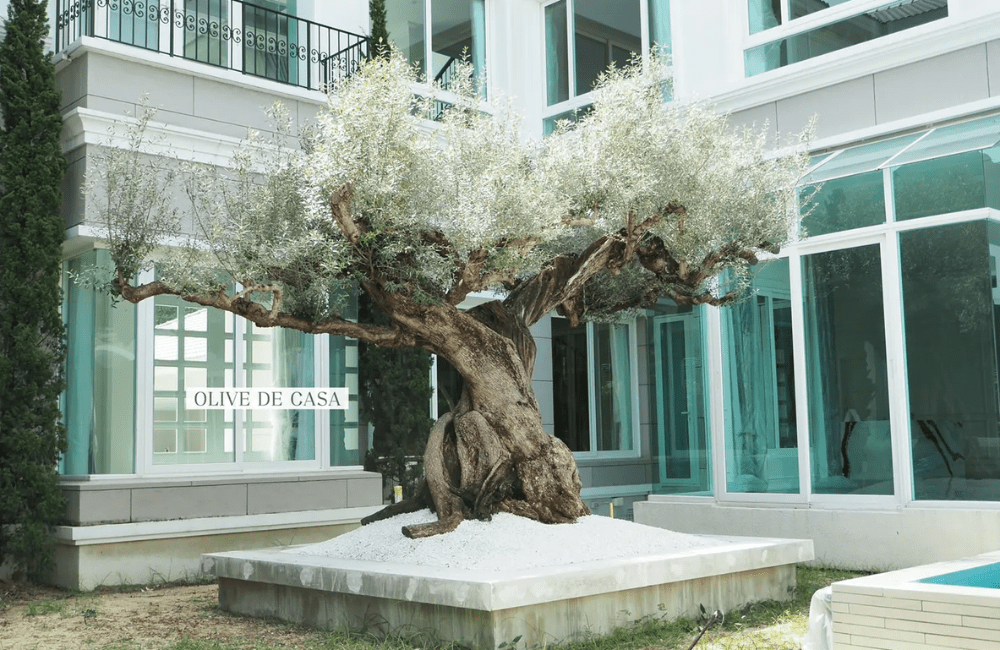
Ten trees to consider
- Olive tree. Silver-green leaves and an architectural trunk make it a focal tree. Its canopy and shade depend on the specimen and pruning; give it drainage and room for mature growth rather than planting close to a structure by default.
- Son bai phai (สนใบพาย). This Thai market name is used for a shaped ornamental. Confirm its botanical identity, mature size and suitability for the available space before using it as a screen or feature.
- Lam sam (ล่ำซำ). Valued locally for a broad, leafy crown and an auspicious name. Plan the mature canopy and leaf litter instead of assuming its roots grow only straight down.
- Champi (จำปี). A fragrant flowering tree whose mature height and spread need room. Allow access for pruning and cleaning around paths and buildings.
- Peep (ปีบ). A tree with a comparatively open crown and fragrant flowers. Check the specific site’s light, maintenance and available clearance.
- Kan krao (กันเกรา). Chosen for an evergreen impression and fragrant flowers; ask for the mature dimensions of the stock offered and provide enough rooting area.
- Saraphi (สารภี). A flowering tree to consider where its mature size suits the garden. Select it for the actual site rather than relying on a blanket claim that it cannot affect nearby surfaces.
- Phikun (พิกุล). A denser canopy can give substantial shade, but may also make a small garden darker. Position it for both light and long-term access.
- Khae na (แคนา). A more open tree with showy flowers. Account for seasonal litter and the mature crown near parking or paving.
- Kaeo mukda (แก้วมุกดา). A smaller-scale flowering option in some gardens. Confirm the plant offered and whether its final size fits the space.
Plan around the tree that will exist later
Mark overhead wires, underground pipes and the building’s edge before selecting a planting point. Compare the mature crown with the space and check root-zone drainage. Avoid putting a large tree in a small pit and expecting pruning to solve a location problem. Our olive-tree planting guide covers practical preparation for a suitable specimen. A landscape professional or arborist can assess difficult sites, existing paving or nearby foundations.
Frequently asked questions
How far should a shade tree be from a house?
There is no universal distance for all ten trees and all sites. Use the mature dimensions and ask a qualified local professional where foundations, walls or buried services are close.
Can an olive tree provide shade?
Yes, a suitable canopy can shade a surface, but coverage depends on the individual tree’s size and form. Olive may serve more as a sculptural focal point than a broad shade canopy on some sites.
Which trees should be kept away from a small house plot?
Avoid any tree whose expected mature size or root space exceeds what the plot can provide. Review the exact tree and site rather than relying on a permanent species blacklist.