In Thailand, the word son appears in the market names of several trees with narrow leaves or a pine-like outline. These names do not all identify true pines in the genus Pinus. Before choosing a tree, ask the nursery for its botanical name and care information for that exact plant. Here are five market names to recognise when comparing ornamental trees.
Five names to explore
1. Son bai phai (สนใบพาย)
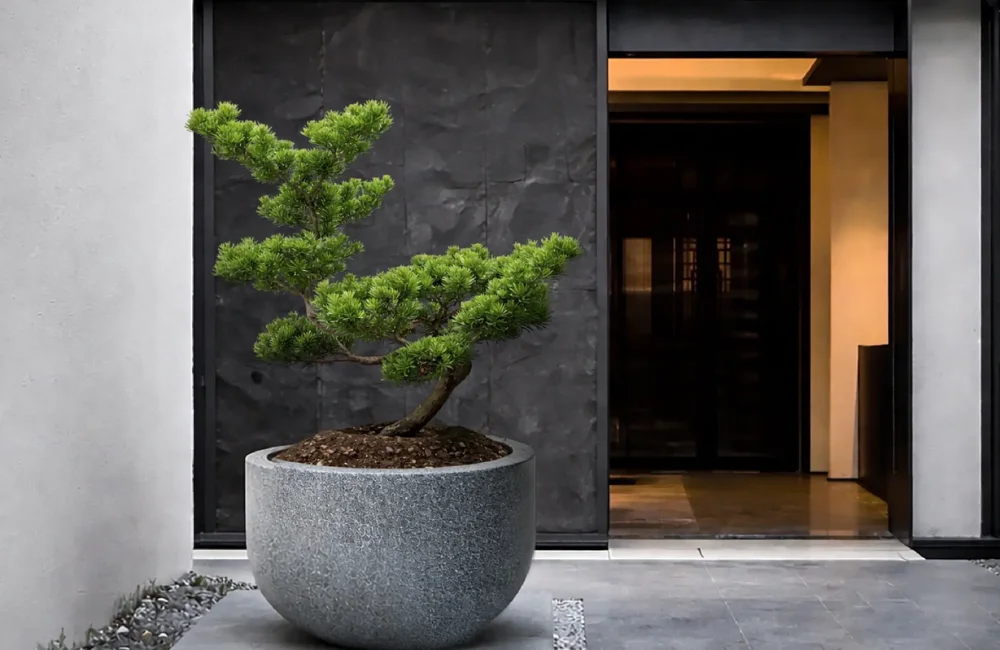
This market group has flat, paddle-like leaves and is often trained into a sculptural form or kept in a large pot. Olive De Casa also shows it in its Thai Podocarpus collection. Confirm the botanical identity of the individual tree before following species-specific care advice.
2. Son hang krarok (สนหางกระรอก)
Fine, soft-looking foliage and an upright outline make this a textural choice. Ask how wide and tall the exact stock will grow, especially when planning a row along a boundary.
3. Son Thai / son pradiphat (สนไทย / สนประดิพัทธ์)
These labels may be used for taller trees suited to open sites. The Thai government’s biodiversity database identifies son pradiphat as Casuarina junghuhniana, a different genus from true pines; do not assume every tree sold as son Thai has that identity. Check the particular tree’s space, exposure and planting suitability.
4. Son blue (สนบลู)
Blue-green or silvery foliage and a conical form can create a cool-toned accent. The market label alone is not enough to determine a species or its tolerance of local heat and rainfall; request the plant’s exact identity and site requirements.
5. Son mangkon (สนมังกร)
An upright, twisting silhouette can work as a feature plant or grouped screen. Inspect the actual branching, mature size and pruning needs of the stock offered.
Choose for the site, not the label
Start with mature size, available root space, light, drainage and how much shaping the design needs. A container requires room for roots and a way for excess water to leave. A tall tree needs a more generous long-term position. Photograph the nursery label and ask for the botanical name when a local market name covers more than one plant.
For the specifically identified Podocarpus macrophyllus, UF/IFAS describes growth in full sun or partial shade and recommends well-drained soil. That guidance should not be copied to every plant sold under a Thai son name. See our companion planting and care guide for a site-first checklist.
Frequently asked questions
Are all of these true pines?
No. Son is used in several Thai common names. The exact botanical identity matters more than the shared market word.
Can one grow in a pot?
Some stock can be grown in a suitable container, but eventual size, drainage and watering needs depend on the identified plant. Select a container and maintenance plan for that specimen.
Is a small “dwarf” tree always easy indoors?
No. Size alone does not establish indoor light and care requirements. Confirm the species and assess the light available before placing a living tree inside.
For more on the identification, see the Thai biodiversity record for Casuarina junghuhniana.